


Do You Need Winter Tires on a Chevrolet Silverado 1500 in Joliet?

When Northern Illinois winter tightens its grip on Will County, full-size truck owners often assume that heavy curb weight and a robust four-wheel-drive system are all that is required to conquer sub-zero temperatures, dense slush, and sheet ice. However, the short answer to whether you should equip your Chevrolet Silverado 1500 with dedicated winter tires in Joliet is an emphatic yes. While four-wheel drive (4WD) provides torque distribution to all four wheel hubs, it does nothing to alter the fundamental physical interaction between your tire's tread compound and frozen pavement.
Standard all-season tires utilize rubber compounds formulated to withstand high summer ambient temperatures. Once the thermometric reading drops below 45 degrees Fahrenheit (7 degrees Celsius), the synthetic polymers within standard tread compounds undergo a hardening process known as glass transition. The rubber stiffens, losing its ability to conform to subtle micro-textures in the road surface. In contrast, dedicated winter tires incorporate specialized hydrophilic rubber compounds infused with high silica content, allowing the tread to remain pliable, flexible, and adhesive even when Arctic cold fronts sweep across the Des Plaines River valley.
Driving a full-size pickup like the Silverado 1500 across Joliet's primary corridors—such as Jefferson Street, Essington Road, and Route 59—presents unique challenges during winter storms. A Silverado 1500 has a gross vehicle weight rating (GVWR) that often exceeds 7,000 pounds when loaded. Stopping that substantial momentum on slick ice requires maximum friction. Dedicated winter tires deliver critical stopping power, shortened braking distances, and vital lateral stability, keeping your vehicle safely in its lane regardless of how severe the winter precipitation becomes.

Why Four-Wheel Drive Cannot Replace Winter Tire Traction on I-80 and Local Streets

A common misperception among truck drivers in Will County is that engaging 4WD High or AutoTrac automatic four-wheel drive compensates for inadequate tire grip. It is vital to separate drivetrain capability from tire adhesion. Your Silverado's transfer case routes engine torque to the front and rear axles to help you accelerate out of deep snowbanks or navigate unplowed residential side streets in Joliet. However, four-wheel drive provides absolute zero assistance when you press the brake pedal or steer around a sudden obstacle on Interstate 80.
Every vehicle on the road—whether it is a front-wheel-drive sedan, an all-wheel-drive crossover, or a heavy-duty 4x4 pickup—relies on four contact patches, each roughly the size of a standard adult shoe print. When applying the brakes on frozen pavement, braking force is governed entirely by Newton's laws of motion and the mechanical coefficient of friction between the rubber compound and the ice surface. If your tires have hardened into rigid plastic due to sub-freezing weather, 4WD cannot generate traction out of thin air.
Lateral stability (cornering capability) is another critical area where 4WD reaches its mechanical limits. When crossing bridges over the Des Plaines River or navigating curved exit ramps off I-80 onto Houbolt Road during freezing rain, black ice forms rapidly. Black ice is a transparent layer of surface ice that lacks visible warning cues.
Without the thousands of microscopic surface sipes engineered into purpose-built winter tires, an all-season tire will break traction laterally, causing the rear end of an empty truck bed to swing out in a dangerous tail-spin. Dedicated winter tires feature high-density, multi-wave siping patterns that flex and open up under steering load, creating sharp biting edges that bite directly into sheet ice and packed snow to keep the Silverado firmly under your control.

Braking, Towing, and Handling: Key Winter Tire Advantages for Silverado 1500 Trucks
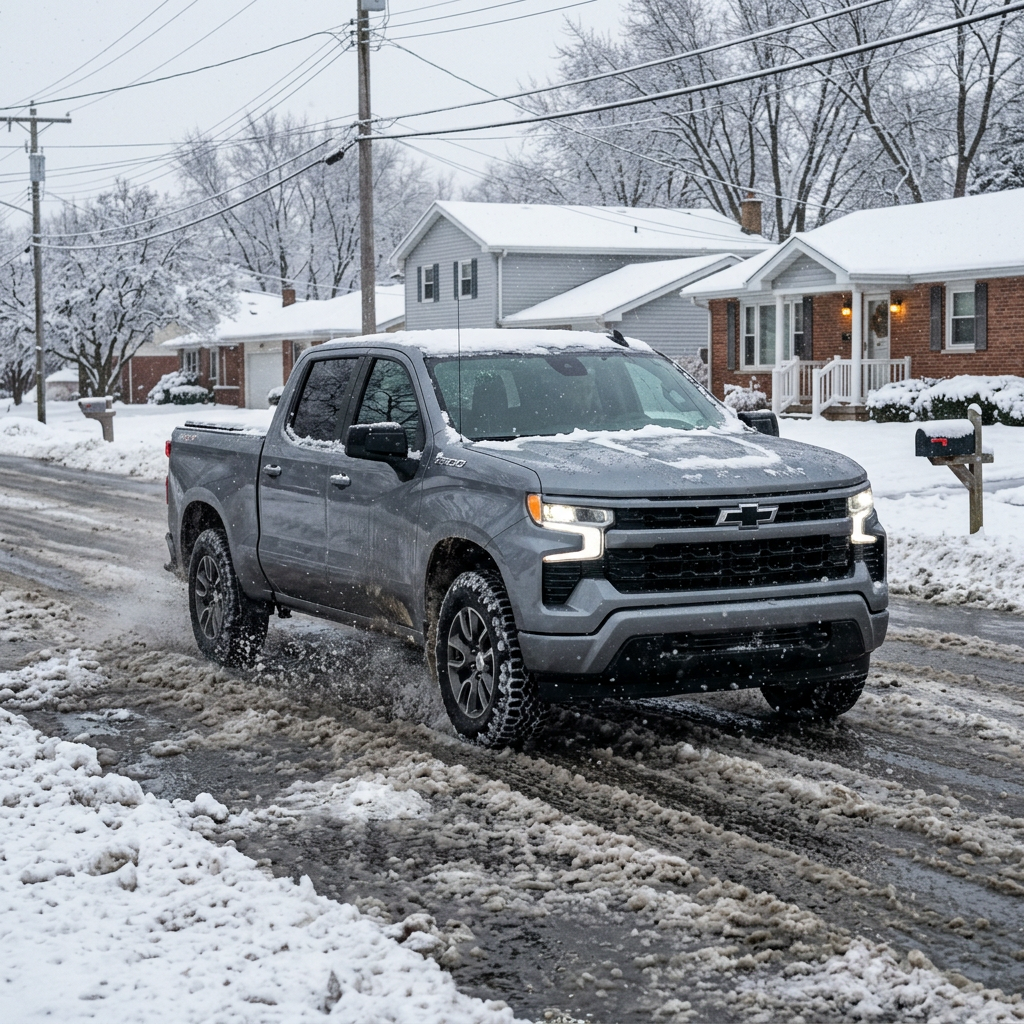
A gray Chevrolet Silverado truck driving through deep snow and slush on a suburban street. (Representative image for illustration purposes only. Actual vehicle may vary based on trim and configuration.)

Up to 30% Shorter Braking

Automotive engineering testing confirms that dedicated winter tires can reduce stopping distances on ice and packed snow by up to 30% compared to standard factory all-season tires. At 35 mph on a slushy Joliet street, that 30% reduction equals multiple car lengths—often the exact difference between coming to a safe stop at a red light on Larking Avenue and sustaining a high-cost front-end collision.

Hauling & Towing Stability

Towing enclosed trailers or carrying heavy payloads of tools, equipment, or building supplies in a Silverado bed shifts the truck's dynamic center of gravity. When trailering on icy highway corridors connecting Plainfield, Naperville, and Joliet, winter tires keep the rear axle firmly planted. Extra tread block rigidity prevents trailer push or dangerous jackknife instability during emergency deceleration.

Slush Evacuation Tread

Midwest winter storms frequently dump thick, wet, heavy slush that clogs fine all-season tread patterns. Winter tires feature aggressive wide directional grooves and self-cleaning tread designs specifically calibrated to channel slush, water, and deep snow away from the tire footprint, maintaining constant direct mechanical grip with the underlying asphalt.

Comparing All-Season Tires vs. Dedicated Winter Tires for Will County Drivers

Understanding the engineered differences between tire categories enables Silverado drivers to make informed safety investments. While M+S (Mud and Snow) rated all-season tires provide adequate performance in mild autumn rain or light spring slush, they lack the specific engineering characteristics required to manage Northern Illinois zero-degree winter snaps.

Feature / Attribute

All-Season Tires

Dedicated Winter Tires (3PMSF)

Optimal Temp Range

Above 45°F (7°C)

Below 45°F down to sub-zero

Rubber Compound

Firm rubber designed for high summer wear resistance

High-silica, hydrophilic soft compound pliable in arctic cold

Siping Density

Moderate straight sipes for water evacuation

High-density 3D zigzag sipes creating thousands of biting edges

Ice Traction Rating

Basic friction resistance

Severe Snow Service Certified (3-Peak Mountain Snowflake symbol)

Braking Distance on Ice (30 mph)

Baseline (Longer stopping distance)

Up to 25–30% shorter stopping distance

If you are considering equipping your vehicle with proper cold-weather rubber, you can easily Order Genuine Chevrolet Parts and factory-approved wheel packages through our dedicated tire center. Our specialists will ensure your tire pressure monitoring sensors (TPMS) are correctly calibrated to your Silverado's onboard computer system.

What Engine Coolant and Oil Viscosity Are Required for a Chevrolet Silverado 1500 in Midwest Winters?
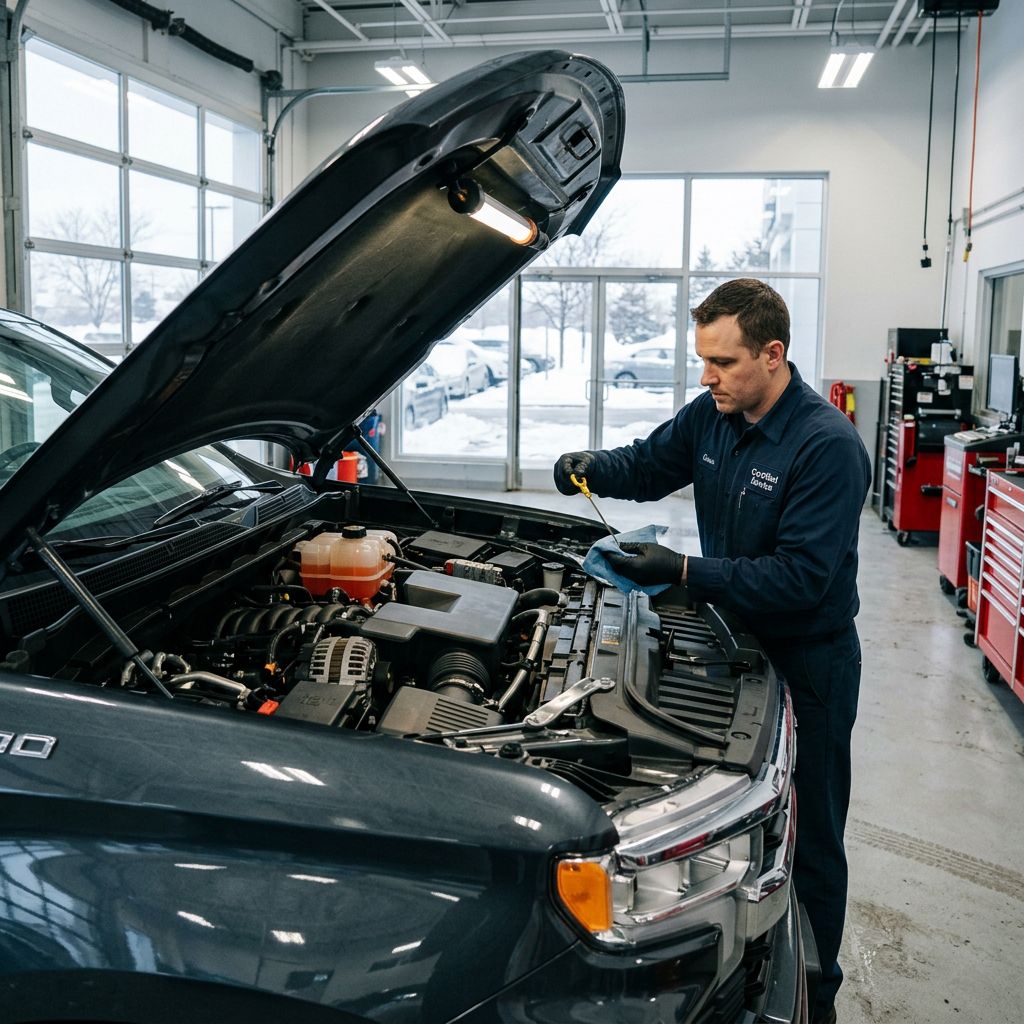
A mechanic in a blue uniform checks the oil dipstick under the open hood of a truck in a repair shop. (Representative image for illustration purposes only. Actual vehicle may vary based on trim and configuration.)
Winter preparation for your truck goes far beyond tires; engine lubrication and cooling system dynamics alter dramatically when temperature gauges plunge below zero in Northern Illinois. Operating a vehicle with thick or incorrect engine oil during arctic cold snaps causes extreme internal friction during startup, accelerating engine component wear before oil pressure stabilizes.
Full Synthetic dexos1™ Oil Viscosity: For the Silverado 1500 equipped with the 5.3L EcoTec3 V8 or 6.2L EcoTec3 V8, Chevrolet specifies factory-approved 0W-20 full synthetic dexos1™ Gen 3 oil. If your Silverado features the 2.7L TurboMax engine, 0W-20 dexos1 is also mandated. The '0W' designation signifies zero-weight cold flow viscosity. Under freeze conditions, 0W-rated synthetic oil flows effortlessly to the overhead camshafts, valve train, and crankshaft bearings within milliseconds of turning the ignition key.
For Silverado trucks equipped with the 3.0L Duramax® Turbo-Diesel inline-six engine, General Motors mandates specialized dexosD 0W-20 diesel-specific synthetic oil engineered to handle low-temperature cold cranks while managing soot and emissions systems effectively. Never substitute conventional 10W-30 or non-approved mineral oils, as doing so can trigger engine fault codes, damage oil pumps, and void factory powertrain warranties.
Dex-Cool® Extended Life Engine Coolant: Vehicle owners often forget that engine coolant is equally critical in winter as in summer. General Motors specifies a strict 50/50 concentration mix of genuine Dex-Cool® coolant and deionized water. This precise mixture protects your radiator, water pump, and engine block from freeze-up down to -34°F (-37°C). If the mixture contains excessive water due to past top-offs, the coolant can freeze, expand, and fracture the engine block or radiator core. Professional hydrometer testing during seasonal service ensures your freezing point threshold remains fully compliant.

Essential Winter Prep: Wiper Blade Replacement and Brake Care for ICE and EV Models

Wiper Blade Replacement Schedule

How often should windshield wiper blades be replaced on a Chevrolet Equinox or Silverado 1500 before winter? Automotive experts recommend replacing wiper blades every 6 to 12 months, ideally right before freezing weather arrives. Summer UV rays and heat dry out natural rubber edges, causing severe streaking when clearing heavy snow or road salt spray on I-55.

Gasoline Truck Brake Maintenance

Salt and liquid magnesium chloride used by Will County road crews accelerate rotor corrosion and cause caliper slider pins to seize. Pre-winter brake inspections verify pad thickness, clean slide hardware, lubricate pins, and flush moisture-contaminated brake fluid to prevent line freezing during harsh low-temperature spikes.

Chevrolet EV Brake Care

What seasonal maintenance is required for Chevrolet EV brakes in icy road conditions? Because electric vehicles (like the Silverado EV or Blazer EV) rely heavily on regenerative braking, mechanical friction brakes are engaged less frequently. This allows road salt build-up and rust oxidation to form rapidly on brake rotors. Seasonal EV service includes manual pad lubrication and mechanical burnishing tests.

How the Chevrolet Equinox AWD System Performs in Seasonal Snow and Required Maintenance
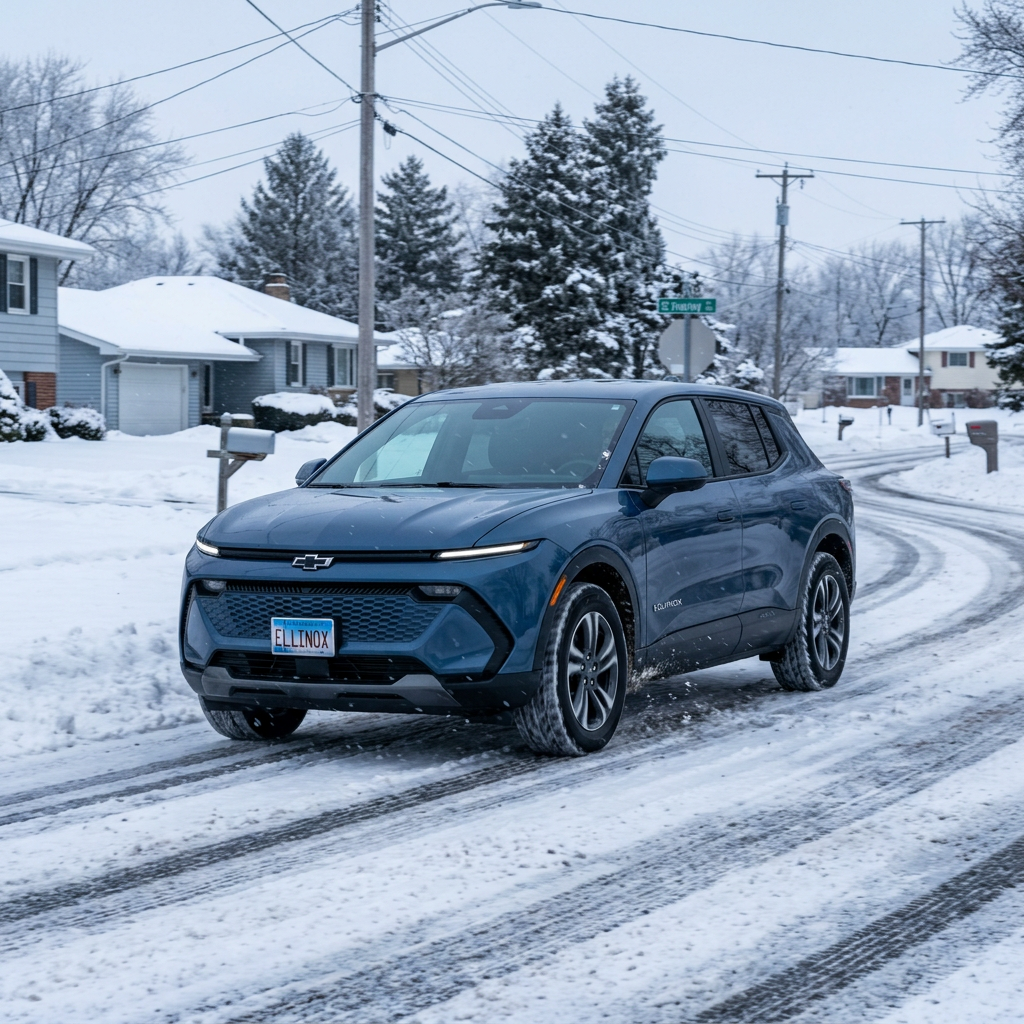
Many Will County households operate both a full-size Chevrolet Silverado 1500 truck and a compact crossover like the Chevrolet Equinox. Understanding how the Chevrolet Equinox AWD system performs in seasonal snow helps drivers maximize safety across their entire family fleet.
Unlike the Silverado's heavy-duty truck 4WD transfer case with 4-High, 4-Low, and AutoTrac settings, the Chevy Equinox utilizes an intelligent, switchable All-Wheel-Drive system. When AWD mode is engaged by the driver, the vehicle continuously monitors wheel speed, throttle position, and steering angles. If sensors detect front wheel slip on slushy Joliet roads, power is electro-mechanically routed to the rear wheels within a fraction of a second.
A blue Chevrolet Equinox EV driving along a snow-covered suburban street during winter. (Representative image for illustration purposes only. Actual vehicle may vary based on trim and configuration.)
To maintain optimal AWD response throughout winter, routine maintenance requires checking fluid levels in the rear differential and power transfer unit (PTU). Old fluid containing metallic shear particles can degrade clutch pack engagement in freezing temperatures. Pairing Equinox AWD with cold-weather tires delivers exceptional winter stability for daily commuting.

Chevrolet Seasonal Maintenance Guide: What Should Joliet Drivers Check Before Winter?

Before Northern Illinois experiences its first significant snowfall or sub-zero night, performing a thorough vehicle inspection prevents frustrating morning breakdown emergencies. Below is the comprehensive checklist recommended by certified Chevrolet technicians:
• 12V Battery Cold Cranking Amps (CCA): Automotive batteries lose up to 35% of their starting power at 32°F and up to 60% at 0°F. Have your battery load-tested to ensure adequate cranking reserve. • Tire Pressure Monitoring System (TPMS) Calibration: For every 10-degree drop in ambient temperature, tire inflation drops approximately 1 PSI. Cold weather under-inflation causes uneven tread wear and reduced fuel economy. • HVAC Heater Core and Window Defrosters: Verify that front windshield defroster ducts and rear glass heating elements function properly to ensure clear operator visibility. • Windshield Washer Fluid: Replace summer bug-wash fluid with winter-grade anti-freeze washer fluid rated down to -20°F or lower. • Comprehensive Inspection: Does Chevrolet offer multi-point vehicle inspections as part of routine maintenance? Yes! Every certified service appointment at Hawk Chevrolet includes a multi-point check covering belts, hoses, steering linkage, shocks, exhaust systems, and brake lining thickness.

Navigating Snow and Black Ice on Plainfield, Naperville, and Joliet Commutes
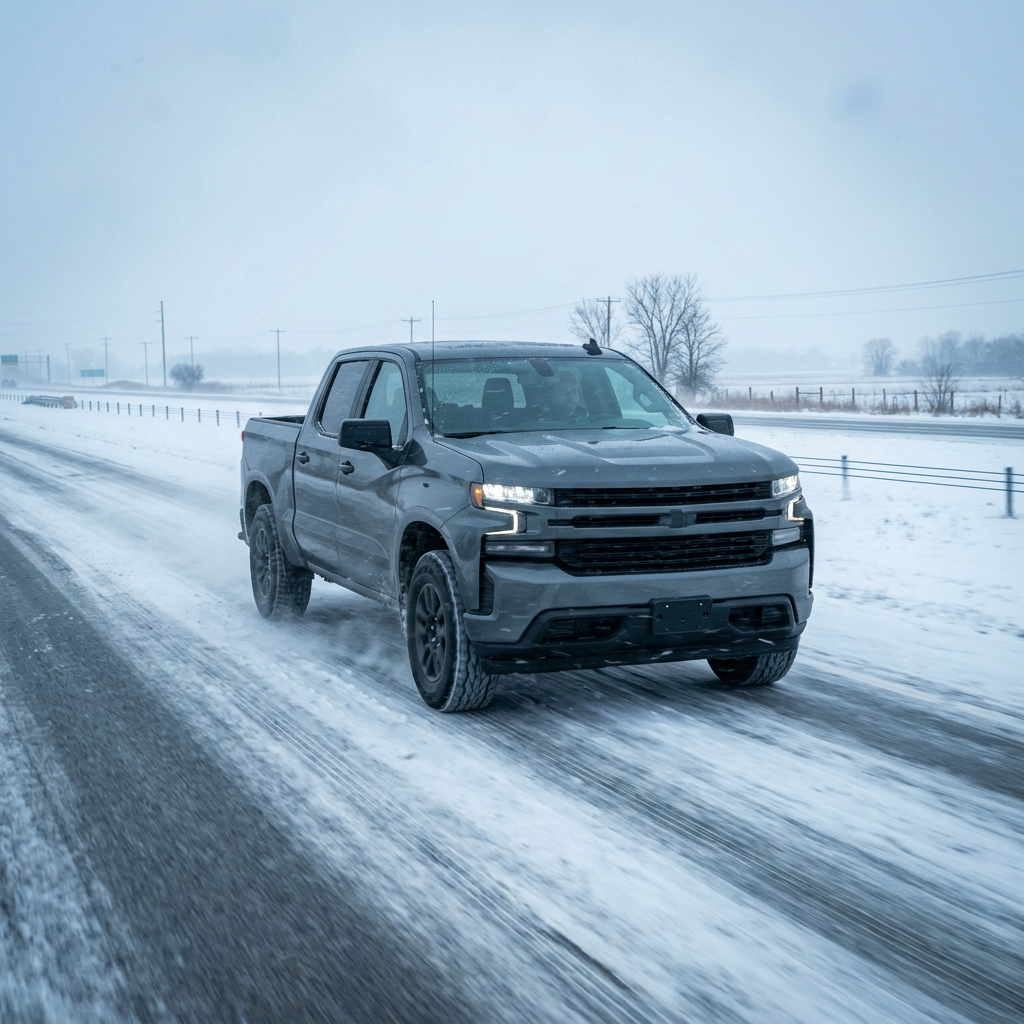
A gray Chevy pickup truck driving down an icy, snow-covered highway during a winter storm. (Representative image for illustration purposes only. Actual vehicle may vary based on trim and configuration.)
Commuting between Joliet, Plainfield, and Naperville during peak winter months demands defensive driving awareness combined with proper Silverado chassis hardware. Major thoroughfares like Route 59, Interstate 55, and Lincoln Highway (Route 30) frequently encounter sudden ground blizzards and flash freezing when moisture blows off open agricultural fields.
When navigating these routes, utilize your Silverado's StabiliTrak® Electronic Stability Control with Proactive Roll Avoidance. On winter-equipped models, StabiliTrak operates in seamless synchronization with tire traction limits, making micro-adjustments to engine torque and individual brake calipers before a skid can develop. Double your following distance behind salt trucks and snowplows, and avoid cruise control usage on wet or icy pavement.

Why Choose Chevrolet Certified Service for Seasonal Maintenance Over Third-Party Shops

Factory-Trained Techs

Why choose Chevrolet Certified Service for seasonal maintenance over third-party shops? GM-certified technicians complete intensive factory training specific to Silverado powertrain architecture, transfer case calibration, and EV high-voltage safety systems.

Genuine GM Parts

Certified service centers use exclusively ACDelco and Genuine GM OEM parts, fluids, and factory-approved winter tires engineered to exact vehicle manufacturer specifications, maintaining your bumper-to-bumper warranty protection.

GM Diagnostic Tools

Independent garages often lack GM Techline Connect software capable of performing module flash updates, ABS sensor recalibrations, or specialized TPMS matching required when swapping seasonal tire packages.

Selecting, Storing, and Ordering OEM Winter Accessories and Tire Packages in Joliet
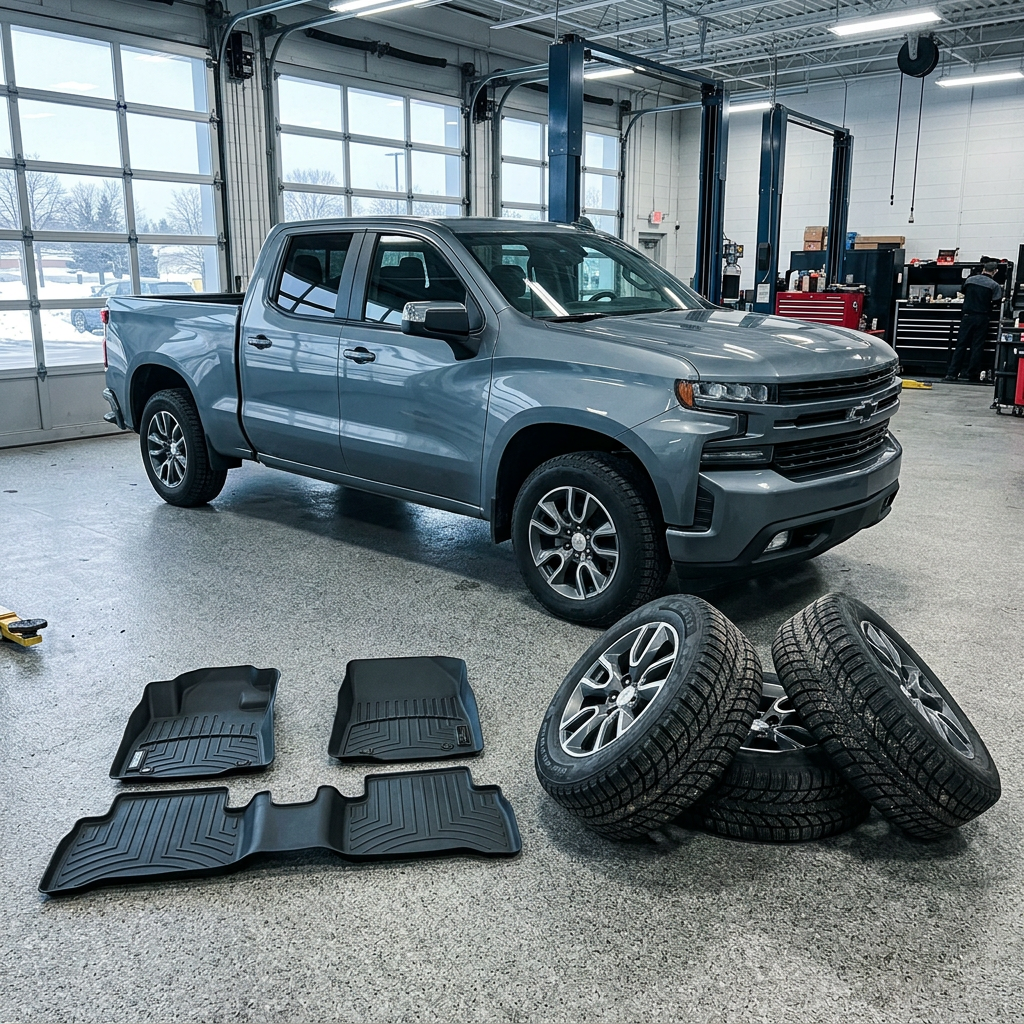
Preparing your Chevrolet Silverado 1500 for winter involves selecting the right wheel and tire combinations as well as protecting your cabin interior from salt and snow slush. Factory winter wheel packages often downsize the wheel diameter (e.g., converting a 20-inch summer wheel to an 18-inch winter wheel) while maintaining overall tire outer diameter. This narrower footprint cuts through deep snow more effectively.
Protect your interior floor carpets by outfitting your cabin with GM OEM heavy-duty premium all-weather floor liners. When storing your summer tires during off-season months, clean them thoroughly, store them upright or stacked in a cool, dry environment away from direct sunlight, and protect them from electric motor ozone sources.
Grey Chevrolet Silverado pickup truck in a service garage with all-weather floor mats and mounted tires in front. (Representative image for illustration purposes only. Actual vehicle may vary based on trim and configuration.)

Schedule Your Silverado 1500 Winter Maintenance at Hawk Chevrolet of Joliet

Don't wait for Northern Illinois freeze events to leave you stuck on the side of the road. Ensure your Chevrolet Silverado 1500, Equinox, or EV is fully equipped to handle black ice, deep slush, and harsh freezing temperatures across Will County.
Visit our service department at 2001 W Jefferson St, Joliet, IL 60435. You can Get Directions to Hawk Chevrolet of Joliet or Call us at (815) 472-8001 to speak with a service advisor. You can also explore options to Value Your Trade or Browse New Inventory online today.
 

Subscribe to Our Blog