What Driving and Tire-Wear Symptoms Signal a Front-End Alignment Problem?
As a certified Service Advisor at Hawk Chevrolet of Joliet, I speak with drivers every day who notice subtle changes in how their vehicle drives across Will County roads. A front-end alignment problem rarely happens overnight; instead, it manifests through gradual warnings that compromise your control, wear down your tires prematurely, and force your engine to work harder than necessary.
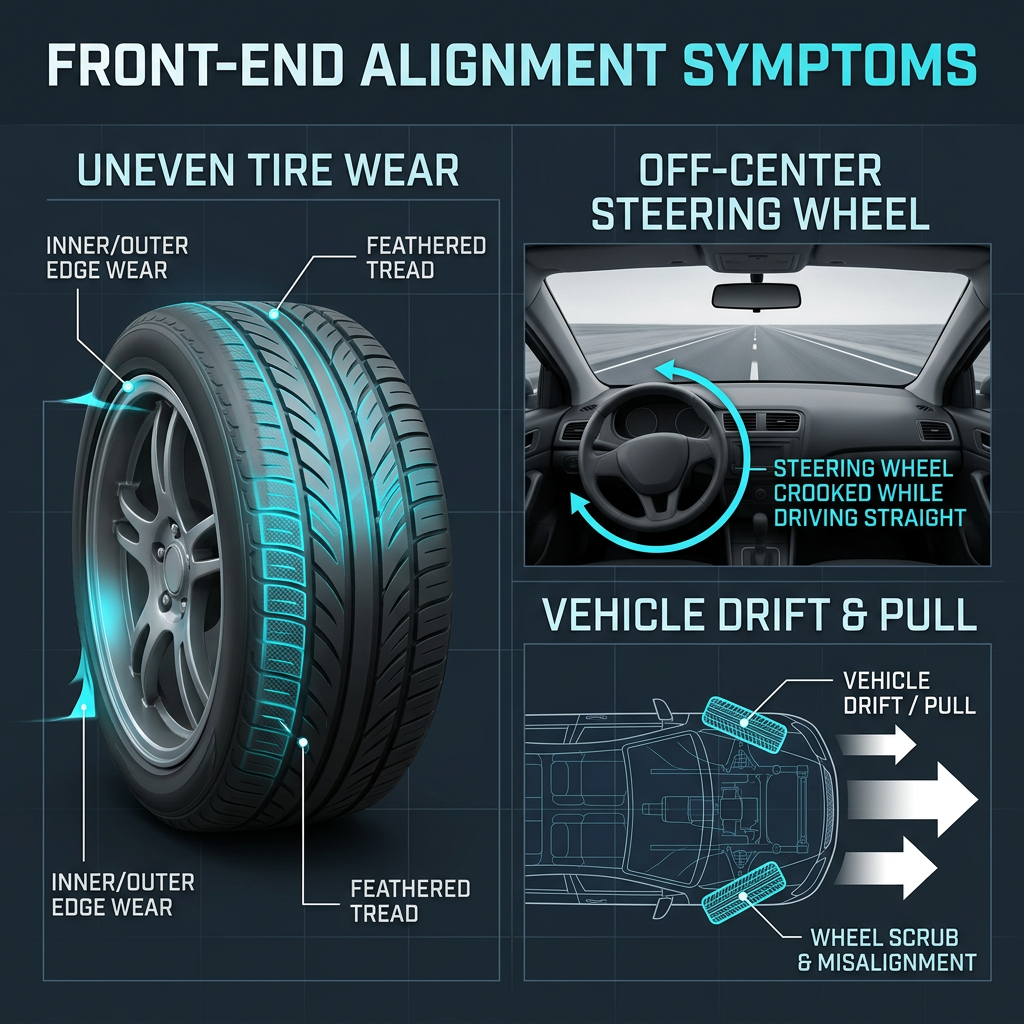
The primary signs that your vehicle urgently requires a front-end alignment include a steady drift or pull to one side while cruising on flat stretches of Route 59 or I-55, a steering wheel that sits off-center when traveling straight, feathering or uneven tread wear along the edges of your front tires, and a persistent wandering feel that requires constant micro-corrections.
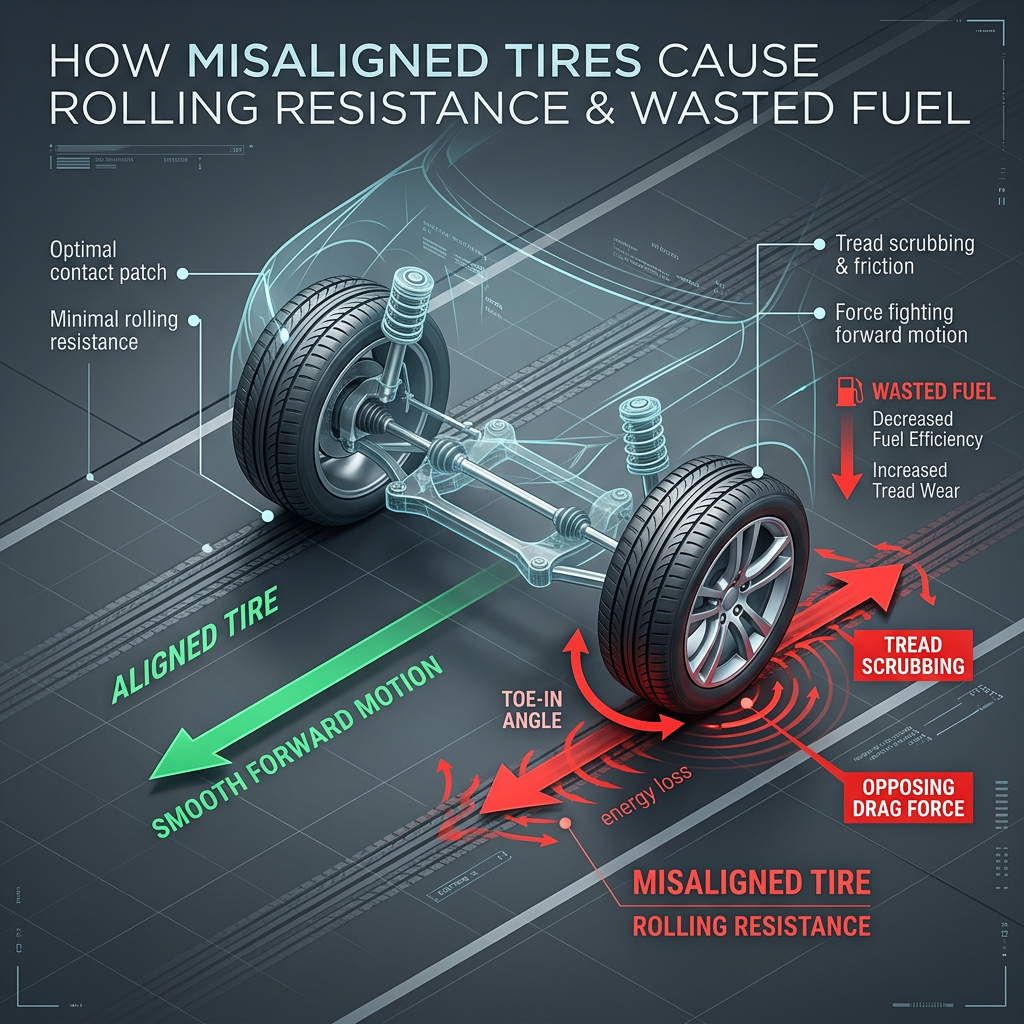
Ignoring these early warning indicators does far more than create an annoying driving experience. When your vehicle's steering geometry falls out of factory spec, every revolution of the wheel causes your tires to scrub against the asphalt rather than roll smoothly. Catching these symptoms early protects your investment, maintains optimal fuel efficiency, and prevents accelerated wear on costly suspension components.
Expert Perspective: Insights From a Factory-Trained Service Advisor
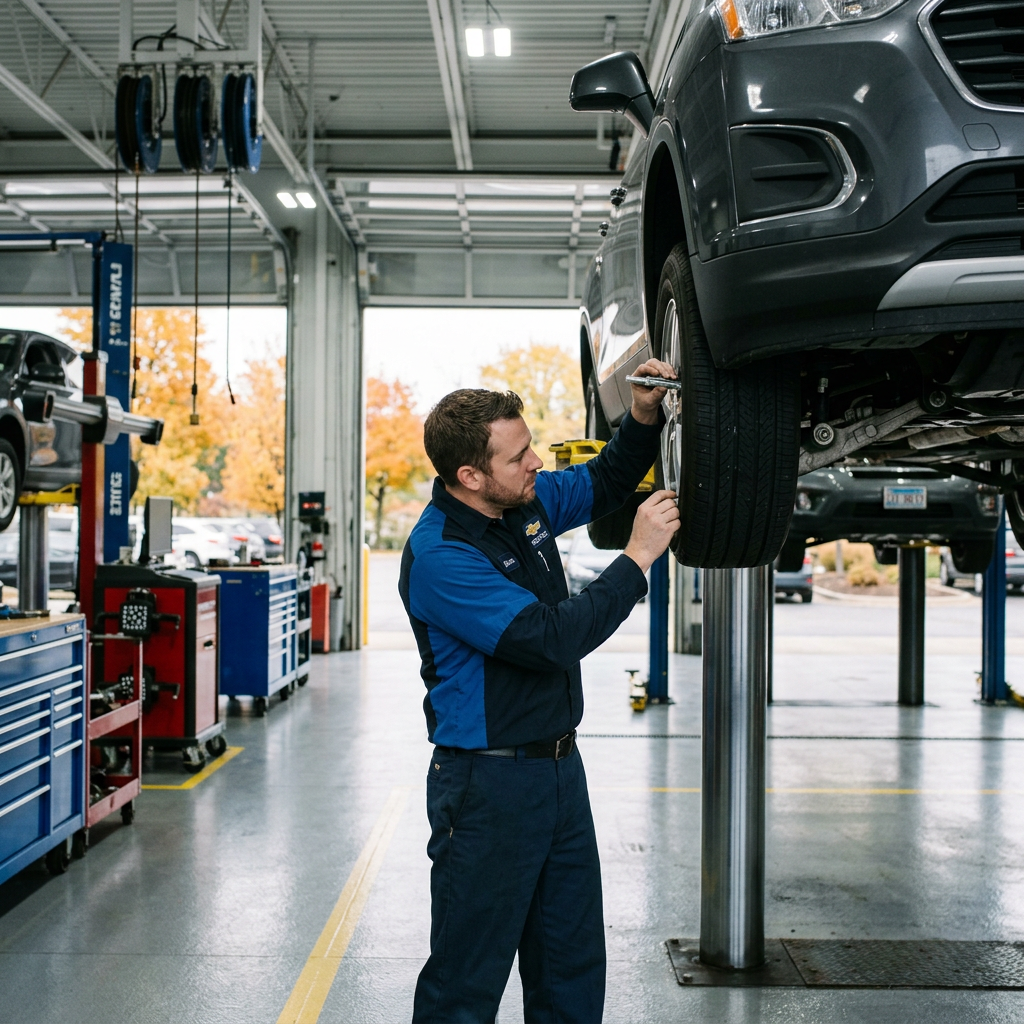
With years of hands-on experience on the service floor at Hawk Chevrolet of Joliet, I have diagnosed thousands of steering gear, wheel alignment, and tire wear anomalies across Chevrolet models and all major makes. Serving drivers from Joliet, Plainfield, and Naperville gives our service team deep insight into how local driving environments impact chassis geometry.
My daily routine involves examining real-world tread wear patterns using high-precision digital tread depth gauges and state-of-the-art computerized lasers. What looks like simple rubber degradation to the untrained eye often tells a complete story of severe alignment drift caused by harsh road impacts, worn bushings, or subtle steering gear misalignments.
Our factory training equips us to look beyond quick fixes. We evaluate how camber, caster, and toe specs interact with modern electronically assisted steering modules and electronic stability control systems, ensuring that your vehicle leaves our bay handling exactly as the engineers intended.
What Are the Most Common Signs That a Vehicle Needs a Front End Alignment While Driving?
Vehicle Pulling or Drifting to One Side: When traveling along a smooth, level stretch of pavement, your vehicle should naturally maintain a straight path with minimal driver input. If you notice your car constantly veering left or right, forcing you to maintain continuous pressure on the steering wheel, your front wheels are fighting against each other.
Off-Center Steering Wheel Position: Pay close attention to the Chevrolet emblem on your steering hub while driving straight down a level road. If the logo sits crooked or tilted at an angle while the vehicle moves straight forward, the steering rack and tie rod adjustments are improperly centered relative to the front wheels.
Steering Wheel Wander and Loose Response: A properly aligned front end provides crisp, predictable center feel. If your steering feels sloppy, sluggish, or requires constant small corrections during highway cruising on I-55, improper caster or toe angles are preventing the wheels from self-centering naturally.
Squealing Tires During Gentle Turns: If your front tires emit a sharp squeal or chirp when executing slow-speed turns or negotiating parking garages around Joliet, excessive toe-in or toe-out setting is causing the tread blocks to scrub sideways across the pavement surface.
Spotting Tire-Wear Symptoms: Feathering, Camber Wear, and Heel-Toe Tread Patterns
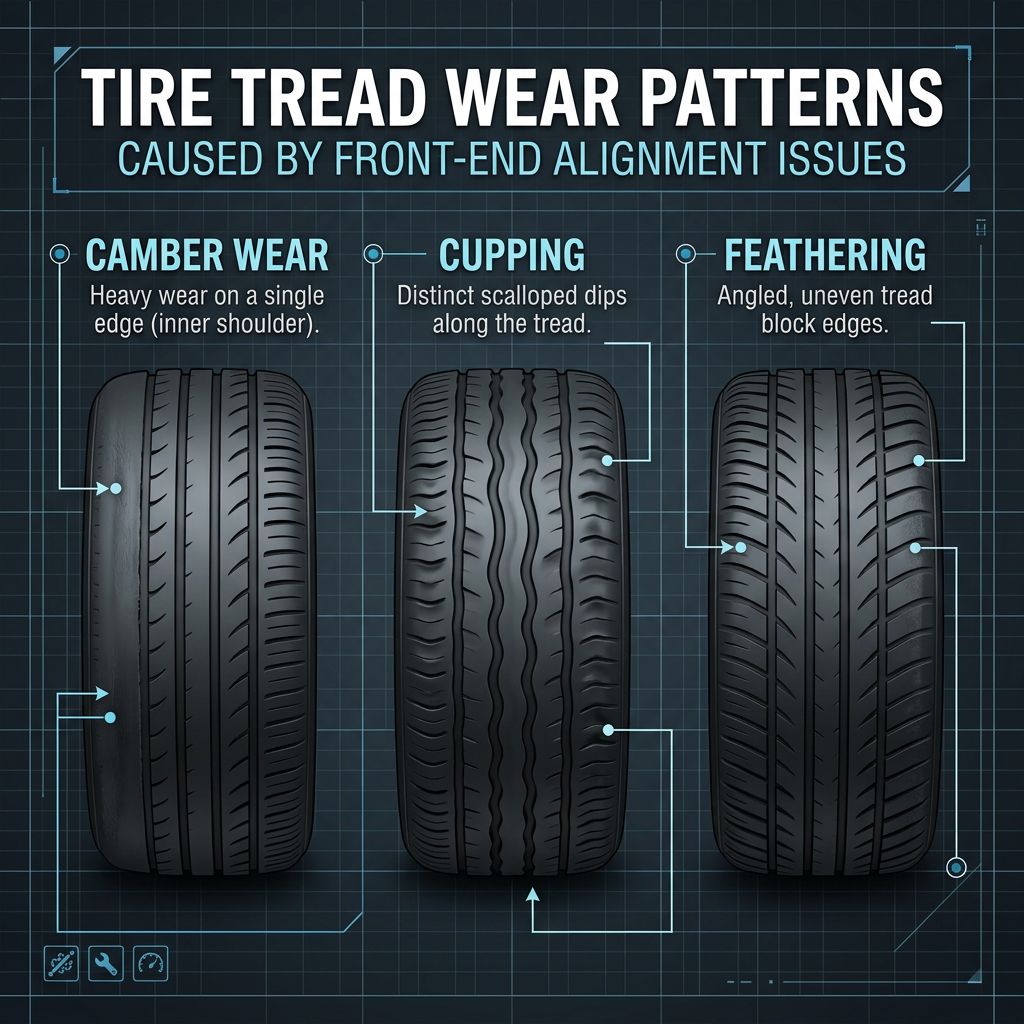
Your tires act as an open record of your suspension's health. By learning how to read tread wear patterns, you can spot alignment issues long before they destroy your tires or compromise road grip.
Feathering
Feathering occurs when tread blocks become smooth on one side and sharp on the other. Run your hand across the tread width; if it feels smooth sliding one way but catches sliding back, incorrect toe adjustment is dragging the tire sideways as it turns.
Camber Wear
Single-edge wear occurs when either the inner shoulder or outer shoulder wears down substantially faster than the rest of the tire. This clear pattern indicates excessive negative or positive camber tilt, leaning the tire weight onto one side.
Cupping / Scalloping
Cupping manifests as random scalloped dips or scoops carved out along the edge or surface of the tread. This indicates a combination of alignment misalignment and worn shock absorbers, allowing the tire to bounce unnaturally.
What Are the Symptom Differences Between Unbalanced Wheels and Bad Alignment?
Drivers frequently confuse wheel balance issues with front-end alignment problems because both negatively affect steering feel and tire longevity. However, the physical mechanics and underlying symptoms are distinct.
Wheel Imbalance: An unbalanced wheel occurs when weight is distributed unevenly around the tire and rim assembly. This primary symptom is speed-sensitive vibration felt directly through the steering wheel, floorboards, or seat, typically escalating between 55 mph and 70 mph.
Bad Alignment: Misalignment refers to improper directional angles of the suspension geometry. Misaligned wheels cause vehicle pulling, steering drift, off-center steering wheel position, and uneven shoulder tread wear—often without creating any high-speed vibration at all.
If you experience both steering wheel shaking and lateral drift, your vehicle likely suffers from both issues simultaneously. Schedule Your Service Today with our team to perform a computerized laser alignment analysis and dynamic wheel balance.
What Key Angles and Specifications Are Measured During a Front End Alignment?
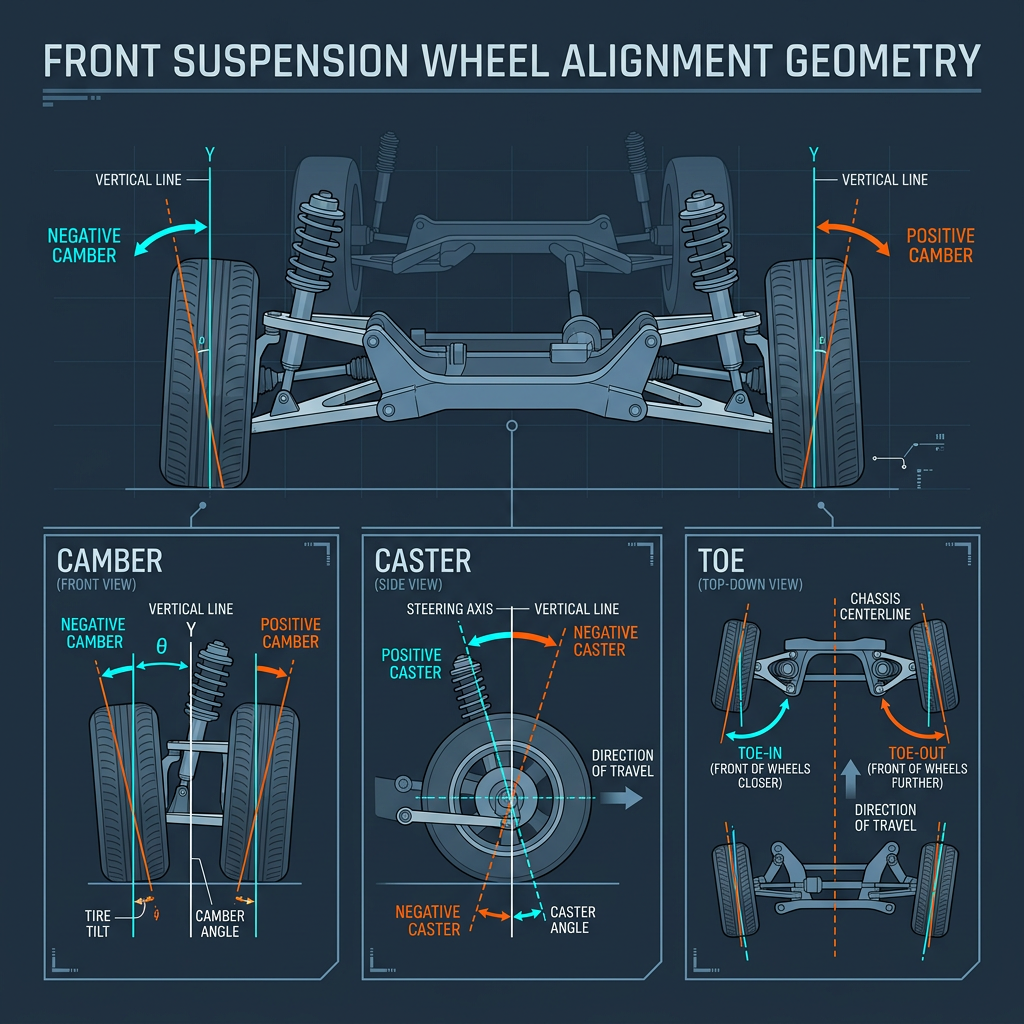
Achieving factory precision requires adjusting three fundamental geometric angles relative to your chassis centerline. Our factory-certified technicians measure these angles in fractions of a degree using computerized optics.
Camber Angle
Camber is the inward or outward tilt of the tire when viewed from the front. Excessive negative camber tilts the top inward, wearing the inner tread. Excessive positive camber tilts the top outward, scrubbing the outer shoulder.
Caster Angle
Caster is the forward or backward angle of the steering axis when viewed from the side. Proper positive caster ensures high-speed stability and allows the steering wheel to snap back naturally after completing a turn.
Toe Angle
Toe measures the extent to which tires point inward (pigeon-toed) or outward (duck-footed) when viewed from directly above. Toe is the single most critical setting for preventing high-speed tire scrubbing and rapid wear.
Service Advisor Quote: Why Ignoring Minor Steering Pulls Leads to Major Suspension Repairs
"A subtle steering pull might seem like a minor annoyance that you can put off until your next oil change, but mechanically, it's a silent countdown. When your front wheels aren't rolling parallel to each other, every mile subjects tie rod ends, ball joints, control arm bushings, and wheel bearings to severe lateral shear forces they were never engineered to absorb. What starts as a simple $100 alignment adjustment can quickly turn into a $1,500 suspension overhaul if neglected."
— Service Advisor, Hawk Chevrolet of Joliet
How Much Extra Fuel Money Can Bad Alignment Waste Per Year?
When your vehicle's wheels are misaligned, your engine must overcome constant rolling resistance or 'drag.' Imagine pushing a shopping cart with a crooked front wheel—you have to exert far more effort just to move straight forward. The exact same mechanical dynamic occurs under your hood.
Automotive engineering studies reveal that severe wheel misalignment increases rolling resistance sufficiently to penalize fuel efficiency by up to 10%. For daily Chicagoland commuters traveling 15,000 miles per year between Joliet, Plainfield, and Chicago, that efficiency drop adds up rapidly at the gas pump.
At current fuel prices, a 10% penalty translates to wasting between $200 and $350 in gas every year. Combined with premature replacement of $800 tire sets, neglecting front-end alignment is one of the costliest maintenance omissions a car owner can make.
Why Are Alignments on Modern Advanced Vehicles More Expensive?
On older vehicles, performing a front-end alignment was a strictly mechanical task: turning tie rod sleeves and adjusting eccentric camber bolts until the wheels pointed straight. On modern Chevrolet cars, trucks, and SUVs equipped with Advanced Driver Assistance Systems (ADAS), alignment is a high-tech calibration process.
ADAS & Safety Sensor Recalibration: Technologies like Lane Keep Assist, Automatic Emergency Braking, Adaptive Cruise Control, and Forward Collision Alert rely on windshield cameras and front bumper radar sensors aligned precisely to the vehicle's geometric thrust line.
Steering Angle Sensor (SAS) Resets: Modern electric power steering systems utilize digital Steering Angle Sensors. If physical wheel angles are adjusted without resetting the digital SAS module, safety systems can trigger error codes or apply erratic steering corrections.
At Hawk Chevrolet of Joliet, our factory-certified technicians utilize specialized target boards and diagnostic software to perform full ADAS recalibration alongside mechanical alignment adjustments, ensuring your safety features operate flawlessly.
How Northern Illinois Road Conditions Accelerate Alignment Issues in Joliet and Naperville
Living in Will County presents unique hazards for automotive suspensions. Our harsh seasonal transitions and heavy industrial traffic create local road conditions that rapidly knock wheel angles out of factory tolerances.
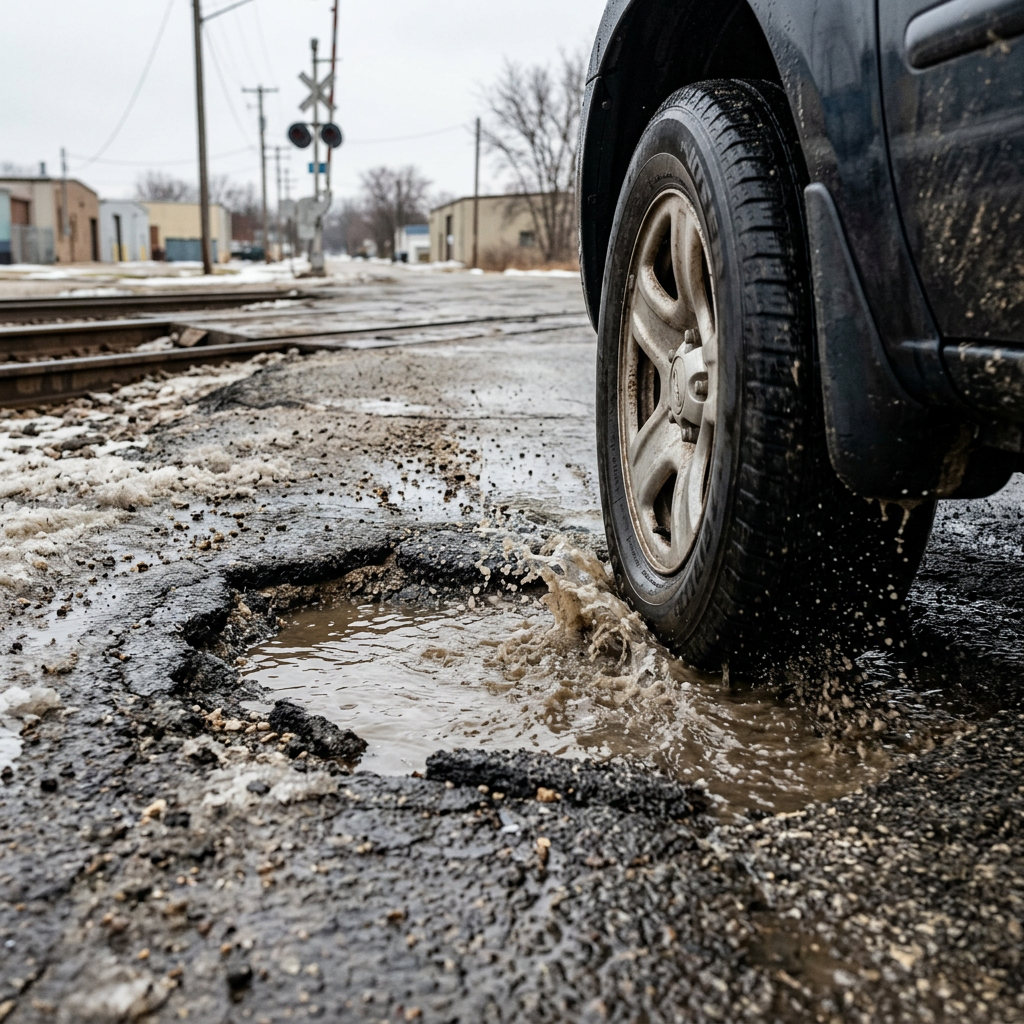
Freeze-Thaw Potholes
Fall and winter moisture seeps into asphalt cracks, expanding when frozen and blowing out pavement under heavy traffic on I-55 and Route 59. Hitting a deep, sharp pothole at 45+ mph can instantly bend tie rods or knock strut towers out of alignment.
Joliet Railroad Crossings
As a historic rail hub, Joliet features numerous industrial railroad crossings. Crossing raised tracks repeatedly subjects your lower control arm bushings and steering linkages to violent vertical impacts that cause alignment settings to drift over time.
Suburban Curb Snags
Clipping a concrete curb while parking in tight Naperville or Joliet shopping centers exerts lateral leverage against front steering knuckles. Even minor low-speed curb strikes are sufficient to alter toe angles and tilt camber settings.
The DIY Front-End Alignment Symptom Checklist: When to Book Service
Use this quick monthly diagnostic checklist to evaluate whether your vehicle requires professional steering and suspension inspection:
• The Flat Road Drift Test: On an empty, level road, safely release steering grip for 2-3 seconds. Does the vehicle track straight, or does it veer rapidly toward the shoulder?
• The Visual Tread Depth Inspection: Insert a penny head-first into inner, center, and outer tread grooves across both front tires. Is Lincoln's head more visible on one shoulder than the other?
• The Touch Test: Gently run your fingers sideways across front tire tread blocks. Do you feel sharp, saw-toothed edges (feathering)?
• The Steering Wheel Level Check: Is your steering wheel emblem level while traveling straight at 40 mph?
• Mileage Interval Check: Has it been more than 12,000 miles or 12 months since your last professional alignment check?
If your current vehicle exhibits multiple severe alignment and suspension failures—and the required repair bill exceeds the practical value of an older car—it may be worth exploring Value Your Trade options to upgrade into a reliable new Chevrolet.
Restore Smooth Handling and Protect Your Tires at Hawk Chevrolet of Joliet
Don't let minor alignment drift ruin your tires, compromise your fuel efficiency, or endanger your highway driving safety. The certified service team at Hawk Chevrolet of Joliet is equipped with state-of-the-art laser alignment systems and OEM GM diagnostic tools to restore your vehicle to factory specifications.
Visit us at 2001 W Jefferson St in Joliet, IL 60435, serving drivers from Joliet, Plainfield, Naperville, and across Will County. Call (815) 472-8001 or schedule your service online in under two minutes.